

If you’ve ever sat across from a Chinese factory manager — or worse, stared at a WeChat message that just says “Sorry, we cannot do this price” — you know that supplier negotiation is a different game in China.
The good news? Most Western buyers overpay because they negotiate wrong. Not because they’re bad negotiators, but because they apply Western frameworks to a Chinese context.
This post breaks down what actually works — real tactics, real numbers, and the psychology behind them.
1. The Mindset Shift: Win-Win Is a Trap
Western negotiation 101 teaches “win-win.” Find a deal that makes both parties happy. Sounds great, right?
In China, win-win is a nice way of saying “I got what I wanted and you didn’t lose too much.”
Chinese suppliers enter negotiations expecting a contest. The opening price is rarely their real price — it’s a starting position. If you accept it too quickly, they’ll wonder what they missed and may try to renegotiate later (yes, this happens).
💡 Key Insight: In Chinese business culture, negotiation is expected. If you don’t push back, you signal either (a) you don’t know the market, or (b) you’re desperate. Neither helps your position.
The goal isn’t to crush the supplier — it’s to establish that you are a knowledgeable, serious buyer who deserves their best price from the start.
2. Preparation: Know Everything Before You Talk
2.1 Know the Factory’s Costs
Before any negotiation, calculate the supplier’s approximate cost breakdown:
- Raw material cost — search Alibaba for the input materials’ market price
- Labor — roughly 15-25% of COGS for most Chinese factories
- Overhead & depreciation — usually 10-15%
- Profit margin — typical Chinese factory targets 10-20% gross
If you know steel is at ¥4,500/ton and the product uses 2kg, you know raw material cost is ~¥9. Add labor and overhead, and you have a realistic floor. Don’t name this number — but let it guide your target.
2.2 Get 3 Quotes Minimum
Never negotiate with one supplier in isolation. Always have:
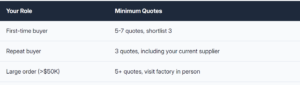
Mention the competition casually: “We’ve received quotes from three factories in your region. We’d like to work with you, but the price gap needs to close.”
2.3 Know Their “Pain Points”
Every factory has a weak spot. Common ones:
- Off-season capacity — Chinese New Year (Feb), summer slump (Jul-Aug), pre-National Day (Oct) — they’d rather fill lines at cost than let them sit idle
- MOQ gaps — if they’re under their target MOQ utilization, they’re flexible
- Need for a reference client — new factories or new product lines will negotiate harder for that first big order
- Cash flow pressure — suppliers with slow-moving inventory or upcoming loan payments will accept lower margins for faster payment terms
3. 5 Battle-Tested Negotiation Tactics
Tactic #1: The “Good Cop, Bad Cop” by Email
This works because it mirrors Chinese decision-making structures. Set up two contacts from your side:
- The Buyer (you): friendly, relationship-focused, the “ally” inside your company
- The Manager (your colleague): strict, data-driven, holds the budget
Script: “I’ve reviewed your quote and honestly I think it’s fair. But our purchasing manager has a hard budget. Can you help me convince them by adjusting the price by X%?”
The supplier feels they have an inside ally. They’ll move to help you — rather than feeling squeezed by you.
Tactic #2: Bundle, Don’t Squeeze
The wrong way: “Your price is too high, can you give a 10% discount?”
The right way: “We’re prepared to commit to a 12-month contract / increase the MOQ / pre-pay 30% deposit. Can you improve the pricing structure?”
Chinese suppliers think in volume and relationship duration. A one-off discount is painful. A long-term volume commitment justifies a structural price reduction. Offer something they value more than the discount hurts.
Tactic #3: The Silence Gambit
After you state your target price, stop talking.
Chinese negotiations often have pauses. Westerners fill silence with justifications, concessions, or small talk. Don’t. Let the silence sit. In many cases, the supplier will fill it with a better offer.
⚡ Pro Tip: WeChat is your friend here. Send your price request and do not follow up for 24-48 hours. The uncertainty often prompts a better counter-offer than if you stay in constant back-and-forth.
Tactic #4: Never Negotiate Price First
Negotiate everything else before price:
- Payment terms (30% deposit → 20% deposit)
- MOQ (2,000 units → 1,000 units)
- Lead time (45 days → 30 days)
- Packaging (standard → custom)
- QC / inspection terms
- Warranty period
By the time you get to price, the supplier has already invested time and energy. They’re less likely to walk away. And you’ve already extracted value elsewhere.
Tactic #5: Use the “Regional Benchmark”
China has distinct manufacturing clusters. Use them against each other:
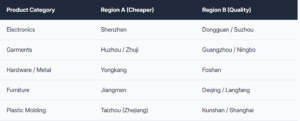
“We’re also looking at factories in Yongkang that can meet the spec at a lower cost. We prefer to work with you, but there’s a gap.”
4. The Payment Terms Leverage Play
This is the single most underutilized lever in Western-Chinese negotiations.
Cash flow is the #1 pain point for Chinese factories. Many operate on thin margins (3-8% net) and carrying receivables for 60-90 days. A supplier who refuses a 3% price cut may happily take a 5% discount for faster payment.
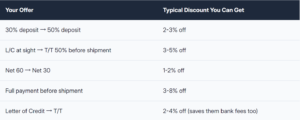
💡 Real example: I negotiated a 7% price reduction simply by switching from 30% deposit + 70% after shipment to 50% deposit + 50% before shipment. The supplier needed cash to buy raw materials for the busy season. Everyone won.
5. Common Traps & How to Avoid Them
Trap #1: The “Let Me Check with My Manager” Stall
You’ll hear this when you’ve pushed them to their limit. It’s a time-buying tactic. Response: Set a deadline. “I understand. We need the final quote by Friday to include in our monthly purchasing cycle.” Creates urgency without being aggressive.
Trap #2: Post-Agreement Price Inflation
You agree on a price. Then the supplier comes back: “Raw material prices increased by 5%, we need to adjust.” Prevention: Include a price-lock clause in your PI (Proforma Invoice): “Price firm for 90 days from date of PI.” Any adjustment requires mutual agreement with supporting documentation.
Trap #3: The “Factory Tour Discount”
You visit. They roll out the red carpet. Great food. Gifts. Then they expect you to pay more. Rule: Enjoy the hospitality, but keep your business head. Visiting should strengthen your position, not weaken it.
Trap #4: MOQ Creep
You negotiate a price at 2,000 units. After a few orders, they say “minimum is now 3,000.” Fix: Negotiate the MOQ downward from the start, or get a written agreement that MOQ is fixed for 12 months.
⚠️ Critical: Never threaten to walk away unless you mean it. If you bluff and they call it, you lose your leverage permanently. Only use the “walk-away” card when you genuinely have a viable alternative supplier.
6. Negotiation Prep Checklist
Before your next negotiation, run through this:
- I have 3+ comparable quotes
- I know the approximate raw material cost for this product
- I’ve identified the supplier’s likely pain point
- I’ve prepared 2-3 non-price items to negotiate (payment terms, MOQ, lead time)
- I have a walk-away price and an alternative supplier ready
- I know which season/month we’re in (off-season = leverage)
- I’ve set a deadline for their final offer
- I’m prepared to be quiet after stating my position
- I’ve planned how to frame this as a partnership, not a confrontation
- I have the final PI reviewed by someone who speaks Chinese (or a bilingual colleague)
The Bottom Line
Negotiating with Chinese suppliers isn’t about aggression or tricks. It’s about:
- Preparation — know the costs, know the alternatives, know the timing
- Psychology — understand that face, relationship, and perceived fairness matter as much as price
- Structure — negotiate non-price terms first, create bundling options, and always have a BATNA (Best Alternative to a Negotiated Agreement)
- Documentation — lock everything in writing on the PI
The best deals aren’t the ones where you squeezed the last penny. They’re the ones where the supplier is still happy to take your call at 9 PM on a Saturday when there’s a production problem — because you negotiated like a partner, not a predator.
📩 Want a PDF version of this negotiation prep checklist? Reply to this blog and I’ll send it to you.