
If you’ve been importing from China for more than six months, you already know the hard truth: the cheapest quote almost never delivers acceptable quality.
But here’s the nuance that most sourcing guides miss — the problem isn’t that Chinese factories can’t make quality goods. Many of them already supply Apple, Tesla, and IKEA. The problem is that you, the buyer, haven’t built a QC system that matches your price point and volume.
After working with hundreds of importers across pet supplies, carbon fiber, and industrial equipment, here’s a practical QC framework that actually works.
1. Pre-Production: The Most Underrated Step
Most buyers jump straight to “inspection before shipment.” Big mistake. By then, 80% of defects are already baked in.
What actually works: Request a Pre-Production Sample (PPS)— not a random sample, but one made from the exact material batch and tooling that will be used in mass production. Specify this in your PO: “PPS must be approved in writing before production starts.”
Cost: $30-80 via courier (DHL/FedEx). One of the cheapest insurance policies in sourcing.
Real example: A client importing silicone pet bowls approved a PPS that looked perfect. The production run used a different mold (same spec on paper) and the silicone density shifted. Wall thickness varied by 0.5mm. If we hadn’t caught it at PPS stage, that was a 20,000-unit recall.
2. During Production (DUPRO) — Don’t Skip This
“DUPRO” (During Production inspection) sounds like extra cost. But here’s the math:
– AQ 2.5 sampling (normal inspection level) on 10,000 units = inspect ~315 pcs
– Cost: ~$200-350 per inspector day
– Or wait for defects to surface 6 weeks later when the container is already on the water
The sweet spot: DUPRO should happen when 20-30% of production is complete. That’s early enough to stop the line, late enough to catch repeat defects.
Red flag to watch: If the factory rushes you through inspection or “can’t find” the DUPRO report template — that’s a sign they’re hiding something in the back half of production.
3. Shipment Inspection: Your Last Line of Defense
Pre-shipment inspection (PSI) gets all the attention, but the sampling method matters more than the inspection itself.
Common mistake: Buyers accept “random sampling” on trust. A factory with poor quality can easily pull 315 perfect units from a batch and ship the remaining 9,685 flawed ones.
Do this instead:
– Require ANSI/ASQ Z1.4 (AQL) — it’s the gold standard
– Specify defect classification: Critical (0%), Major (2.5%), Minor (4.0%)
– Use third-party inspectors only — never rely on the factory’s own QC report
– If the budget is tight, a remote video inspection (WeChat video call + random box-picking) is 70% as effective at 10% of the cost
4. The Hidden “QC Budget” Trap
Here’s a truth no one tells you: your unit price and your QC cost are inversely correlated.
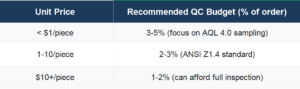
If you’re sourcing pet accessories at 0.80/piece, spending350 on QC for a $5,000 order might feel painful. But one defective shipment — returns, chargebacks, lost Amazon ratings — will cost you 10x that.
5. When the Factory Says “Our QC is Certified”
Many Chinese factories proudly display ISO 9001 certificates. Take them with a grain of salt.
What to actually check:
– Is the QC team independent from production? In small factories (50-100 staff), the workshop manager often double-checks his own work. That’s not QC.
– Do they have calibrated measurement tools? A $10 digital caliper from a local market isn’t calibrated. Ask to see calibration stickers and expiry dates.
– Can they show you their defect log? A blank logbook means defects happen and get swept under the rug.
Quick Checklist Before Your Next Order
– [ ] PPS approved from the production material batch
– [ ] DUPRO inspection at 20-30% completion
– [ ] Third-party PSI using ANSI/ASQ Z1.4 AQL
– [ ] Factory QC independence verified
– [ ] QC budget built into the PO (not an afterthought)
QC isn’t about mistrusting your supplier. It’s about making sure both sides share the same definition of “good enough.” A factory that passes a fair, transparent inspection is a factory you can build a long-term relationship with.
At Vinia Cargo HK, every shipment we manage goes through this three-stage QC flow. It’s not the cheapest way to source — but it’s the only way that keeps clients coming back for years, not weeks.
Have questions about QC for your specific product category? Get in touch — we respond within 24 hours.