
If you’re moving goods between Asia and Western markets, ocean freight isn’t just the cheapest option — it’s the backbone of global trade. But “shipping by sea” can mean vastly different costs, timelines, and headaches depending on how you do it. Here’s a no-fluff breakdown of what actually matters.
FCL vs. LCL: Which One Actually Saves You Money?
The textbook answer is simple: FCL (Full Container Load) is cheaper per unit; LCL (Less than Container Load) is for smaller shipments. In practice, the decision is more nuanced.
Go FCL when:
• Your cargo fills ≥8-10 CBM (cubic meters) — at this point, paying for a full 20GP container (~28 CBM usable) often beats LCL rates per CBM
• You need door-to-door with minimal handling — fewer touches = lower damage risk
• Time-to-port matters — FCL typically books faster and skips consolidation/deconsolidation delays
Go LCL when:
• Your shipment is under 5 CBM — especially for high-value, low-volume goods
• You’re testing a new market and don’t want inventory commitment
• Consolidation services are strong at both origin and destination (more on this below)
⚠️ The hidden LCL trap: Most LCL quotes quote by “revenue ton” (1 CBM = 1,000 kg whichever is greater). If your cargo is heavy but small — say 2 CBM weighing 3,000 kg — you’re paying for 3 CBM-equivalent, not 2. Always check which rate applies.
Key Port Pairs: China ↔ US & China ↔ Europe
China → US West Coast:
• Shanghai → Los Angeles/Long Beach — most frequent sailings, ~12-14 days transit
• Ningbo → Oakland — solid alternative for inland US distribution via rail
• Shenzhen (Yantian) → Seattle/Tacoma — good for Pacific Northwest-bound cargo
China → US East Coast (via Panama):
• Shanghai → Savannah/New York — ~25-28 days transit
• Yantian → Charleston — popular for Southeast US distribution
• Pro tip: For US East Coast, consider a combo of West Coast port + IPI (Inland Point Intermodal) rail to Memphis/Chicago/Dallas — can be 5-7 days faster than all-water via Panama for cargo headed to inland hubs.
China → Europe:
• Shanghai → Hamburg — ~28-32 days, the most mature Asia-Europe route
• Ningbo → Rotterdam — excellent for Benelux distribution
• Shenzhen → Antwerp — strong for central Europe via road/rail from Belgium
• Yantian → Gdansk (Poland) — growing rapidly as an alternative to congested Northern European ports
LCL Consolidation: A Pro’s Playbook
Consolidation is where good forwarders earn their keep. Here’s what separates an average consolidation from a great one:
1. Cargo compatibility: Never mix strongly scented products (chemicals, spices, rubber goods) with consumer goods (textiles, electronics). A single leak can ruin an entire container — and customs may hold everything.
2. Weekly cut-offs matter more than you think: Most LCL consolidation services operate on fixed weekly schedules. If your cargo misses Wednesday’s closing time at origin CFS (Container Freight Station), it waits a full week. Know your CFS cut-off before you book.
3. Destination CFS selection: In high-volume destinations (LA, Rotterdam, Hamburg), some CFS facilities have better customs bond status and extended free time (3-5 days vs. 2 days). Ask your forwarder for CFS with the longest free-time allowance to avoid demurrage charges on LCL cargo.
Shipping Schedule Planning — The Real Way
Schedules are never guarantees. The current reliability rate across major east-west trades hovers around 55-65% for on-time arrivals. Plan accordingly:
• For FCL: Book 3-4 weeks ahead of your ideal sailing. Rollover (being bumped to the next vessel) is common when space is tight.
• For LCL: Book 2 weeks ahead. LCL space is usually more flexible but consolidation schedules are fixed.
• Buffer rule of thumb: Add 7-10 days to the quoted transit time for delivery expectations. If the schedule says 14 days, tell your buyer 21-24 days. Under-promise, over-deliver.
Ocean Freight Surcharges — What’s Real and What’s Negotiable
Base ocean rates are just the starting line. Here’s the standard surcharge stack and which ones you can push back on:
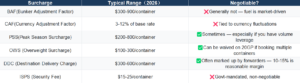
Pro move: Ask for an “all-in rate” that includes BAF, CAF, DDC, and ISPS. On a 3,000 base rate from Shanghai to LA, a good forwarder can often bundle surcharges for3,800-4,200 all-in depending on market conditions. Compare this against piecing them out — transparency doesn’t mean you can’t negotiate the total.
The Takeaway
Ocean freight in 2026 isn’t just about picking the cheapest rate. It’s about understanding the full picture: how your cargo fits into a container, which port pair gives you the best logistics outcome, what your consolidation strategy should be, and what you’re actually paying for beyond the headline number.
If you’re looking for a freight partner that breaks down every line item and helps you optimize container utilization — not just book space — reach out to us at Viniacargo. We handle the complexity so you don’t have to.
If you’re looking for a freight partner that breaks down every line item and helps you optimize container utilization — not just book space — reach out to us at Viniacargo. We handle the complexity so you don’t have to.